The field of digital marketing is evolving faster than ever. Brands and marketers must adapt quickly to stay competitive. If they fail to change, they risk falling behind their competitors.The Digital Marketing Trends You Need to Know in 2026 focus on innovation, technology, and customer behavior. Marketers, business owners, and beginners must understand these trends to stay ahead. By following the latest strategies, they can achieve better results and grow faster in the digital space.
The key digital marketing trends that will shape 2026 are broken down in this guide, along with what you can do now to capitalize on them.
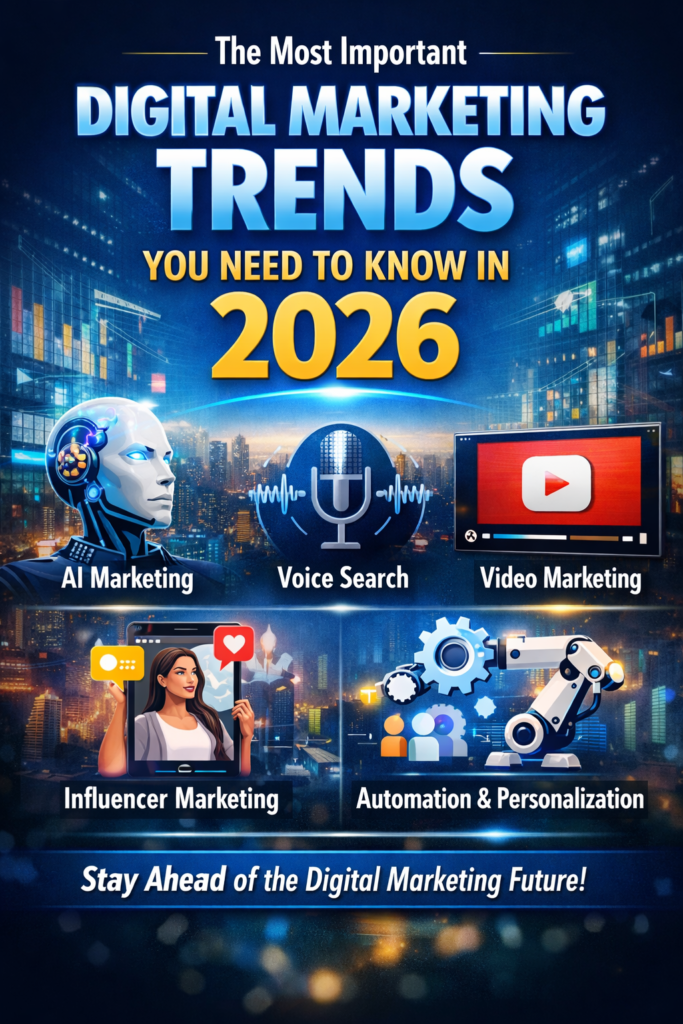
Artificial intelligence is no longer just a trend. It has become a core business requirement. By 2026, marketers will use AI at every stage of the marketing funnel. They will apply it to audience segmentation, content creation, predictive analytics, and personalized email campaigns.
The Digital Marketing Trends You Need to Know in 2026 clearly highlight this shift. Businesses that adopt AI tools can work faster, improve targeting, and deliver better customer experiences.
1. AI-Powered Marketing Is No Longer Optional
Marketers now use AI to deliver highly personalized experiences that increase conversion rates and improve customer engagement. They also rely on AI to optimize ad spend in real time and create high-quality content at scale. In addition, tools powered by large language models help automate customer support, generate marketing copy, and perform SEO research more efficiently. These advancements clearly reflect the Digital Marketing Trends You Need to Know in 2026, where AI plays a central role in improving performance and driving better results.
Key Takeaway: Invest in AI marketing solutions to automate tedious work so that your team can concentrate on strategy and innovation.
2. Short-Form Video Continues to Dominate
In 2026, short-form video content remains one of the most powerful trends in digital marketing. Platforms like YouTube Shorts, Instagram Reels, and TikTok have completely changed how consumers discover products and make buying decisions.
Research shows that video content generates higher engagement than static posts. As a result, brands that use short-form videos in their strategy achieve better brand recall, reach more people organically, and build stronger trust with their audience. These insights highlight why video plays a key role in the Digital Marketing Trends You Need to Know in 2026.
Key Takeaway: Make genuine, worthwhile, 15- to 60-second videos that inform, amuse, or motivate your intended audience.
3. Search Is Evolving: SEO Meets Generative AI
Traditional SEO is evolving rapidly. In 2026, search engines are integrating generative AI into their results pages. As a result, users often get direct answers from AI summaries without visiting websites.
To stay visible, marketers must focus on creating high-quality and well-structured content. They should provide clear answers to specific user queries. In addition, optimizing for key factors like E-E-A-T, structured data, and featured snippets has become more important than ever.
These changes clearly define the Digital Marketing Trends You Need to Know in 2026, where content quality and search intent play a crucial role in ranking and visibility.
Key Takeaway: To satisfy AI-driven search results, change your SEO strategy to focus on topic authority and conversational, question-based content.
4. Hyper-Personalization at Scale
In 2026, consumers expect more than basic personalization like first-name emails. They want fully tailored experiences that match their needs and behavior. Marketers now use AI, behavioral data, and real-time insights to deliver the right message to the right person at the right time.
Hyper-personalization allows brands to create dynamic website content, personalized product recommendations, and automated email sequences. As a result, businesses that master personalization achieve higher customer lifetime value and reduce churn rates. This shift highlights one of the key Digital Marketing Trends You Need to Know in 2026, where customer experience plays a major role in success.
Key Takeaway: Deliver customized content at every touchpoint by properly segmenting your audience using CRM data and behavioral analytics.
5. Social Commerce Is Reshaping Online Shopping
The gap between e-commerce and social media has almost disappeared. In 2026, social commerce has become a major driver of online sales. Consumers can now discover and purchase products directly within platforms like Pinterest, Instagram Shopping, and TikTok Shop. This shift makes the buying process faster and more convenient.
Brands now reduce friction in the customer journey by offering seamless in-app shopping experiences. In addition, influencer marketing, live shopping events, and user-generated content strongly impact purchase decisions. These strategies help brands build trust and increase conversions.
This trend clearly reflects the Digital Marketing Trends You Need to Know in 2026, where social platforms play a key role in driving sales and customer engagement.
Key Takeaway: To easily turn social media followers into customers, set up shoppable posts and make investments in creator partnerships.
6. First-Party Data Is the New Gold
First-party data has become one of the most valuable assets in digital marketing in 2026. Increasing privacy regulations and the decline of third-party cookies have pushed businesses to rely on their own data sources. First-party data includes information collected directly from users through sign-ups, purchases, surveys, and website interactions.
Companies that invest in building strong customer databases, loyalty programs, and email lists gain a significant competitive advantage. They can target audiences more accurately and deliver personalized messaging without depending on third-party platforms. This approach is a key part of the Digital Marketing Trends You Need to Know in 2026, where data control and customer trust drive long-term success.
Key Takeaway: Create your own data ecosystem by using value-driven content, loyalty programs, and lead magnets that entice users to voluntarily submit their information.
Final Thoughts: Stay Agile, Stay Ahead (Digital Marketing Trends You Need to Know in 2026)
The Digital Marketing Trends You Need to Know in 2026 are driven by the growing demand for better customer experiences, advanced technology, and data-driven strategies. From first-party data and social commerce to AI automation and short-form video, businesses that adapt quickly and stay curious will achieve long-term success.
However, you do not need to adopt every trend at once. Instead, focus on two or three trends that align with your audience and business goals. Then test your strategies, measure performance, and make improvements over time. By following this approach, you can build an effective marketing strategy and succeed in 2026 and beyond.