
One of the most important abilities in digital marketing is ranking your website on Google without investing in advertisements. In addition to saving money, organic traffic increases your company’s long-term credibility and trust. (How to Rank Your Website)
Many novices believe that ranking on Google is hard, yet it is totally achievable with the correct approach and perseverance. This article will teach you how to gradually improve your website’s Google ranking without the use of sponsored advertisements.
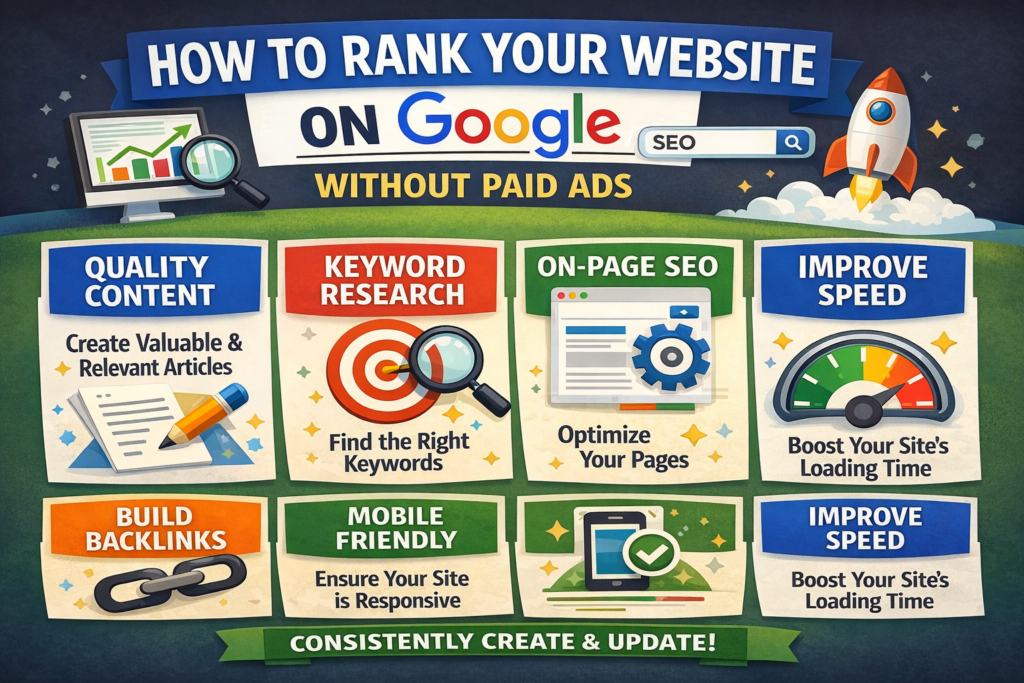
Understand How Google Ranking Works (How to Rank Your Website)
Before you start, it’s important to understand how Google ranks webpages. Google aims to give users the most relevant and useful results.
It considers factors like:
- Quality of content
- Key words
- Performance of websites
- Backlinks
- Experience of users
If your website meets these criteria, it has a higher chance of ranking.
Step 1: Keyword Research
The cornerstone of SEO is keyword research. You must ascertain what individuals are looking for.
Choose keywords that:
- Continue to conduct a lot of searches
- Engage in low- to medium-level competition
- Adhere to your content
For instance, you may focus on “digital marketing for beginners in India” rather than “digital marketing.”
Long-tail keywords attract targeted visitors and are simpler to rank.
Step 2: Create High-Quality Content
The most crucial element in ranking is content. Google favors material that offers users something of value.
To create good content:
- Respond to user inquiries
- Use plain, uncomplicated language.
- Give real-world instances.
- Make sure your content is organized.
Focus on solving problems rather than just writing for search engines.
Step 3: On-Page SEO Optimization
On-page SEO helps search engines understand your content.
Important elements:
- In the title, use your keyword.
- Include keywords in the headings
- Compose a suitable meta description.
- Improve photos with alt text
- Make use of internal links
These minor adjustments have a significant impact.
Step 4: Improve Website Speed
Rankings and user experience are both impacted by website performance. Websites that are slow frequently lose visitors.
To improve speed:
- Compress pictures
- Make use of a quick hosting provider
- Reduce the number of superfluous plugins
- Turn on caching
A fast website keeps users engaged.
Step 5: Make Your Website Mobile-Friendly
The majority of consumers utilize mobile devices to view websites. Mobile-first indexing is also used by Google.
Ensure your website:
- loads correctly on a mobile device
- Easily navigable
- Is receptive
A mobile-friendly website improves rankings and user experience.
Step 6: Build Backlinks
Backlinks are links from other websites to your site. They act as a vote of trust.
Ways to get backlinks:
- Posting as a guest
- Distributing useful content
- Working together with others
- Adding your website to directories
Focus on quality backlinks from relevant websites.
Step 7: Use Internal Linking
Internal linking means linking one page of your website to another.
Benefits:
- Helps users navigate
- Improves SEO
- Increases time spent on your site
Link your blog posts and pages naturally.
Step 8: Optimize for User Experience
User experience plays a major role in ranking.
Improve:
- Website design
- Navigation
- Readability
If users stay longer on your website, Google considers it valuable.
Step 9: Update Content Regularly
Fresh content is important for SEO. Updating your content keeps it relevant.
You can:
- Add new information
- Improve old content
- Fix outdated data
Regular updates help maintain rankings.
Step 10: Use Free SEO Tools
You can use free tools to improve your SEO strategy:
- Google Search Console
- Google Analytics
- Keyword research tools
These tools help track performance and identify areas for improvement.
Common Mistakes to Avoid
Avoid these mistakes while trying to rank:
- Keyword stuffing
- Copying content
- Ignoring technical SEO
- Expecting quick results
SEO requires patience and consistency.
How Long Does It Take to Rank?
It takes time to rank well on Google. Depending on competition and effort, it may take a few weeks to many months.
Consistency is the key. Over time, consistent work produces superior outcomes.
Benefits of Organic Ranking
Ranking without ads provides many benefits:
- Free traffic
- Long-term results
- Higher trust and credibility
- Better return on investment
It is a sustainable way to grow your business.
Conclusion
With the correct strategy, you may rank your website on Google without using paid advertisements. Prioritize user experience, appropriate SEO, and high-quality content.
Maintain consistency, never stop learning, and consistently refine your approach. Your website will eventually begin to receive more visitors and rank higher.
Although organic growth requires time, the benefits are worthwhile.